


Someone, commenting on my previous article “My CEO is a woman,” wrote that it was “sexist.”
I still smile when I think about it. If recounting two concrete and positive professional experiences with women in charge is read as an attack, then perhaps we have touched a raw nerve.
But today I am not telling you another story. Or rather, I am, but this time it is a collective story, made of numbers, studies, and confirmations. Because what I personally experienced with my CEOs—concrete energy, active empathy, true leadership—is not a lucky exception of mine. It is a reality supported by data.
Spoiler: yes, female CEOs work. And no, not “because they are women.” They work because they deliver results. Period.
- When women lead, the company thrives
- Less ego, more vision (and practicality)
- Not just numbers: innovation and people too
- Female CEOs raise the bar for productive efficiency
- But then why are there still so few?
- It is not (only) a matter of ability, but of perception
- What can we do?
- We understand each other, right?
- FAQ
When women lead, the company thrives
Some think that putting a woman at the top is a symbolic gesture.
Something politically correct. A “sign of the times.”
Instead, it is a strategic choice. According to a study by S&P Global, in the two years following the appointment of a woman to lead a company, the stock value increases by an average of 20%. Not bad, right?
And that is not the only interesting data point. The Frank Recruitment Group found that 87% of Fortune 500 companies with a female CEO recorded above-average profits. Those with a man in charge? 78%.
Even in the Fortune 1000, female CEOs achieve better results in terms of growth and profitability.
So no, it is not just inspiration. It is performance.
Less ego, more vision (and practicality)
One of the elements I remember with the most gratitude regarding my CEOs is their ability to manage power without overpowering. To make strong decisions without turning them into a show.
This characteristic also has a scientific name: lower propensity for overconfidence. Women in senior positions, according to research by the EIEF, show better risk management, more solid governance, and more stable growth.
They are less attracted to “flashy” finance and more to stability. Less driven by ego dynamics, more attentive to real impacts.
They do not hold back innovation; on the contrary, they lead it with logic, inclusion, and a sense of the possible.
Not just numbers: innovation and people too
Those who know me know that I strongly believe in the link between leadership and corporate culture. And once again, science agrees. A study by the University of Rome analyzed the impact of female CEOs on innovation, human capital, and investment. Companies led by women invest better, listen more to their teams, and value ideas and people.
It is not about “female humanity,” but about systemic vision. Female CEOs drive a leadership that integrates rather than imposes, that listens rather than isolates, and that leverages what truly works: human capital.
Female CEOs raise the bar for productive efficiency
If there is an example that elegantly and definitively refutes prejudices about female leadership, it is her: Mary Barra, CEO of General Motors since 2014, and the first woman to lead a global automotive giant.
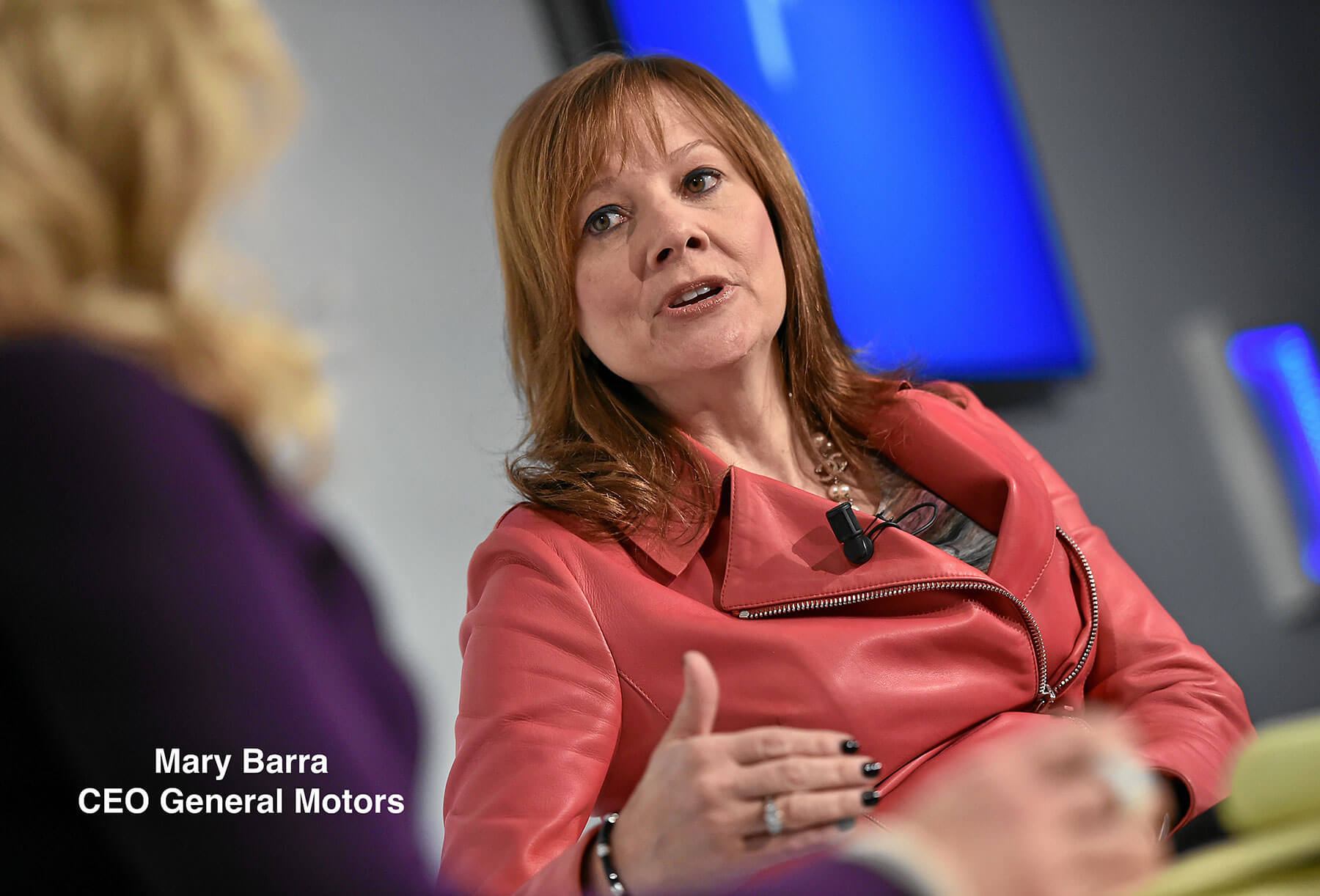
Under her leadership, GM has not only kept pace with a sector in full transformation but has also raised the bar for productive efficiency: in 2024, the company reached an average of 37 vehicles produced per employee, surpassing giants like Toyota (29) and Volkswagen (14). A number that alone tells a story of optimized processes and real teamwork.
But efficiency is not the only data point to shine. GM’s revenue grew from 127 billion in 2021 to 171 billion in 2023, proving that Barra’s strategic vision also works on a financial level.
We are not just talking about numbers, however. Barra has also raised the bar for quality: Chevrolet and Buick are among the most awarded brands according to J.D. Power, the benchmark for reliability in the automotive sector.
And for those who still think the market “rewards something else,” just look at the shareholders: +71.4% total return (stock price + dividends) over the last 10 years. Ford, in the same period, recorded -10.2%.
But perhaps the most important change is the least visible: cultural transformation. Inclusion, diversity, innovation: these are words that Barra has transformed from corporate slogans into daily practice. And it is from there that solid productivity, lasting resilience, and a forward-looking company are born.
But then why are there still so few?
Here is the catch (and a failure of the entire system).
Female CEOs are still very few. In Italy, we are below 4%.
Globally, it hovers around 6%.
And certainly not for a lack of skills.
The reasons are always the same:
- Unconscious bias in selection processes and beyond
- Predominantly male power networks
- Lack of role models
- Imposter syndrome (yes, still present and well-nourished)
As the Stanford Graduate School of Business also points out, when a woman is hired as CEO, the way the company talks about women also changes: It is not just a matter of the “top seat.” It is a powerful cultural lever.
It is not (only) a matter of ability, but of perception
One of the most insidious obstacles to female leadership is not a lack of skills.
It is the double lens through which it is observed.
If a male CEO is decisive, he is authoritative.
If a female CEO is decisive, she is aggressive.
If a man leads with firmness, it is said he “has vision and leadership.”
If a woman does the same, she “always wants to be right” or “doesn’t know how to mediate.”
If a man takes a clear stand, he is determined.
If a woman does so, “she is rigid,” “undiplomatic,” or “needs to calm down.”
A woman with grit is often seen as a “steamroller,” while her male colleague, with the same approach, is celebrated as “the leader we needed.”
These are gender biases. Silent, rooted, and apparently harmless.
Yet they are incredibly powerful in sabotaging the perception of female leadership.
Because it is not enough to be good: one must also survive how that excellence is interpreted.
And this is where the culture needs to change. Not just giving space to women.
But dismantling the frameworks with which we judge them.
What can we do?
We need to move from rhetoric to action. Here is where to start:
1. Normalize female leadership
Let’s stop being surprised when a woman leads a company well. It is normal.
2. Dismantle the frameworks
It is not enough to give space to women: we also need to change the lens through which we view them.
An assertive woman is not “too much.” An empathetic leader is not “weak.” A determined CEO is not a steamroller. She is a CEO, period.
3. Give space to stories
Sharing the stories of those who have made it serves those who are trying. And it helps rewrite the collective narrative of leadership.
4. Change the yardstick
We don’t need to change women to fit the dominant leadership model.
We need to change the model. Stop evaluating potential only through the filter of “grit” or “stage presence.” Leadership can be quiet, effective, and collaborative. And it can work perfectly well.
We understand each other, right?
In my first article, I spoke about lived experiences.
Today I add the evidence.
And together they tell us a powerful truth: female CEOs are not a rarity. They are a resource.
A resource that improves balance sheets, teams, and people.
A resource that does not just “deliver results,” but changes the way we achieve them.
So let’s stop asking if they are ready.
Let’s ask if we are.
FAQ
Read also: “My CEO is a woman” and if you liked this article, share it on your social networks!

